

What is Bluetooth® Low Energy?
KAGA FEI shows you its features and applications.
Bluetooth® Low Energy (hereinafter referred
to as “Bluetooth LE”) is wireless communication technology that is used
for various purposes in our lives.
Bluetooth LE’s key strength, low
power consumption and simple connection, makes it stand out in wireless
communication technologies. Introduced as a part of Bluetooth in
2009, it has been expanding its application field rapidly.
Bluetooth
Low Energy is often referred as BLE, though it is officially described as
Bluetooth Low Energy or Bluetooth LE.
In this column, you can learn
more about Bluetooth LE, the differences between Bluetooth LE and other
wireless technologies, and specific application examples.
What is Bluetooth LE?
Bluetooth is one of the short-range wireless communication technologies. New wireless standard added in Bluetooth 4.0, which was announced in 2009, is known as Bluetooth Low Energy or Bluetooth LE. To distinguish it from Bluetooth LE, the conventional Bluetooth communication method is called Bluetooth Classic.
What is Bluetooth?
Bluetooth is wireless communication technology with low power consumption.
This technology makes it easy and convenient to connect smartphones
and wireless earphones, or laptops and wireless computer
mouses.
Bluetooth is equipped as standard in various devices so you
can find it used in everyday life. We exchange data by variety of
smart devices including wearable devices, fitness trackers or smart watches
via Bluetooth. Users can install devices freely because no cabling is
required.
Features of Bluetooth LE
Bluetooth LE is communication protocol using lower energy than conventional Bluetooth Classic.
<Features>
- Low energy consumption makes it possible
to use battery-powered devices for long period of time.
-
Communication range is about a few to 100 meters. *KAGA FEI also
provides modules for long range communication.
- Low data
transfer rate, which is unsuitable for transferring video data.
For these features, Bluetooth LE is suited for transmitting and receiving comparatively small data. Moreover, it helps you to develop applications easily as it is a function adopted in a variety of smartphones and tablets.

What is version history of Bluetooth?
Bluetooth has been updated since it was revealed as Bluetooth 1.0 in 1999. Bluetooth LE was introduced in Bluetooth 4.0 and it improved power efficiency significantly. Thereafter, it spread to smart devices and became an essential feature for smartphones. Bluetooth LE of Bluetooth 5.0 has better throughput, data capacity, and communication range than the previous version, Bluetooth 4.2.
Differences between Bluetooth LE and Bluetooth Classic
Bluetooth LE is specialized in low power consumption and can be driven by coin-cell battery. On the other hand, its data rate is not that high, which means it is unsuitable for transferring large sized data. In addition, Bluetooth LE and Bluetooth Classic have different applications and no compatibility hence Bluetooth LE’s specifications are different in many ways.
Bluetooth Classic is used for peripheral devices of computer and
smartphone, and digital home appliances, and particularly used for
point-to-point connection including keyboard, computer mouse or
headset.
Meanwhile, Bluetooth LE is used for small data transmission like
sensing data. It has been expanding its application to healthcare,
sports, or IoT devices.
Communication method of Bluetooth LE
Bluetooth LE has two types of communication methods: Connection type and Broadcast type. In Connection type, connection devices are identified, and devices are distinguished as Central and Peripheral. In Broadcast type, communication devices are not identified and transmitting devices make one-way transmission. The devices are distinguished as Observer and Broadcaster.
Central and Peripheral
In Connection type, main device is called Central, and extension device is
called Peripheral. After establishing connection and pairing, Central
and Peripheral can transmit data each other, which also can be encrypted
during the communication.
In most cases, smartphones or laptops apply to
Central, and devices, which requests the connection, like fitness trackers
apply to Peripheral. In this case, smartphone as Central collects data
from fitness tracker as Peripheral, and users can see its results on their
smartphones.
Observer and Broadcaster
In Broadcaster type, Broadcaster is a one-sided transmitter, and Observer
is a receiver which can receive without limits. Beacon is a typical
example of this.
When Smartphones (Observer) get close to beacon devices
(Broadcaster) which are set in specific location, smartphones receive beacon
ID automatically and you can download contents based on the ID using
specific app. This technology is utilized with location information:
receiving vouchers or collecting digital stamps in shops or attractions.
Comparison with Other Wireless Technologies
Difference between Bluetooth LE and Wi-Fi
Compared with Wi-Fi, Bluetooth LE is specialized in low power consumption,
and it is useful to connect several smart devices’ peripherals wirelessly.
On the other hand, transmission speed of Wi-Fi is such high, so Wi-Fi
has strength in downloading large files or establishing intermediate
distance networks. Though its power consumption is large, it is
unsuitable for battery powered use for long terms.
Regarding radio
frequency, Bluetooth LE uses 2.4GHz band and Wi-Fi uses 2.4GHz/5GHz bands.
When you use Wi-Fi at 2.4GHz with Bluetooth LE, radio wave
interference occurs. You need to be careful the connection can be
unstable in such a condition.
Difference between Bluetooth LE and ZigBee
Both Bluetooth and ZigBee are wireless communication technologies with low
power consumption. Bluetooth LE transmits data speedily, and there are a lot
of Bluetooth LE devices in the market, which makes it easier to develop
devices applied to Bluetooth LE. ZigBee is suitable for sensor
networking, and it can also connect several devices at the same time, so it
is used in fields which require large scale network such as industrial
automation. However, fewer products support ZigBee than Bluetooth LE,
so development environments are possibly limited.
The following table
shows a comparison between Bluetooth LE, Wi-Fi and ZigBee. These are
rough estimates since these figures such as communication range and data
speed depend on environments of communication or radio.
Bluetooth LE/Wi-Fi/ZigBee Performance Comparison
| Communication Range | Data Speed | Power Consumption | Application Example | |
| Bluetooth LE | ~ 100m |
Medium (125kbps - 2Mbps) |
Low | Devices run for a long time on a coin cell, Beacon |
| Wi-Fi | ~ 200m |
High (54Mbps – several Gbps) |
Medium | Video streaming, Downloading Large Files |
| ZigBee | ~ 30m |
Low (20 – 250kbps) |
Low | Massive sensor networking |
Application of Bluetooth LE
Bluetooth LE has been used in various fields these days taking advantage of its high usability.
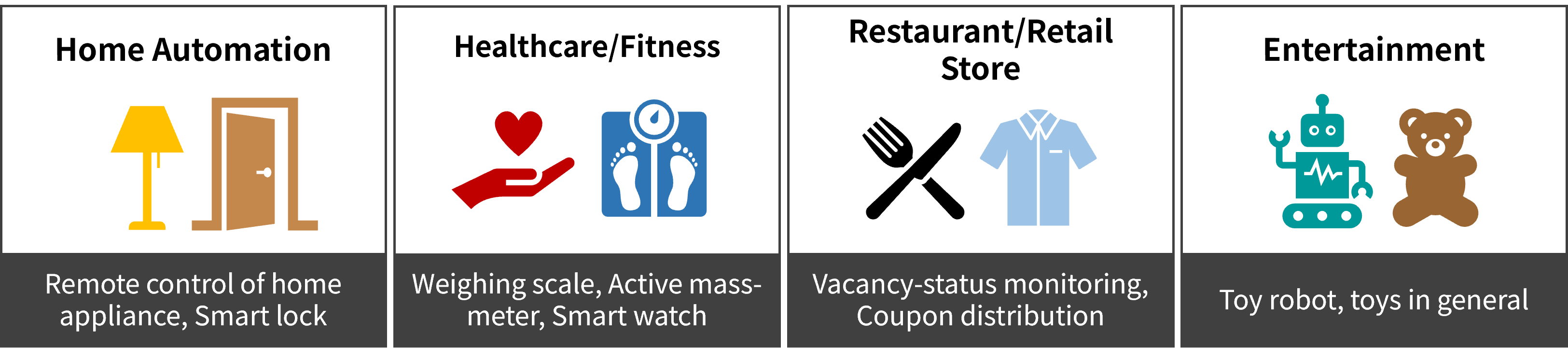
Application of Bluetooth LE
These communication functions can be easily equipped by adopting Bluetooth
LE wireless modules.
Wireless modules are electronic components consisted
of a wireless chip and peripheral circuits mounted on a small
substrate.
KAGA FEI offers more than 20 types of Bluetooth LE wireless
modules, including the world's smallest level ultra-small wireless
module.
Datasheets and specification details for each module are
available on our website.
Summary
We learned the features of Bluetooth LE (Bluetooth Low Energy), its
comparisons with other wireless technologies, and its applications.
Bluetooth LE is used in a variety of applications, especially in the
fields of healthcare, fitness, smart home, and smart home appliances because
of its low power consumption and its easy operation.
As most of the major
smart devices support Bluetooth LE, it is expected to keep playing an
important role in various applications.
If you have any interests in Bluetooth or modules, please feel free to contact us.